
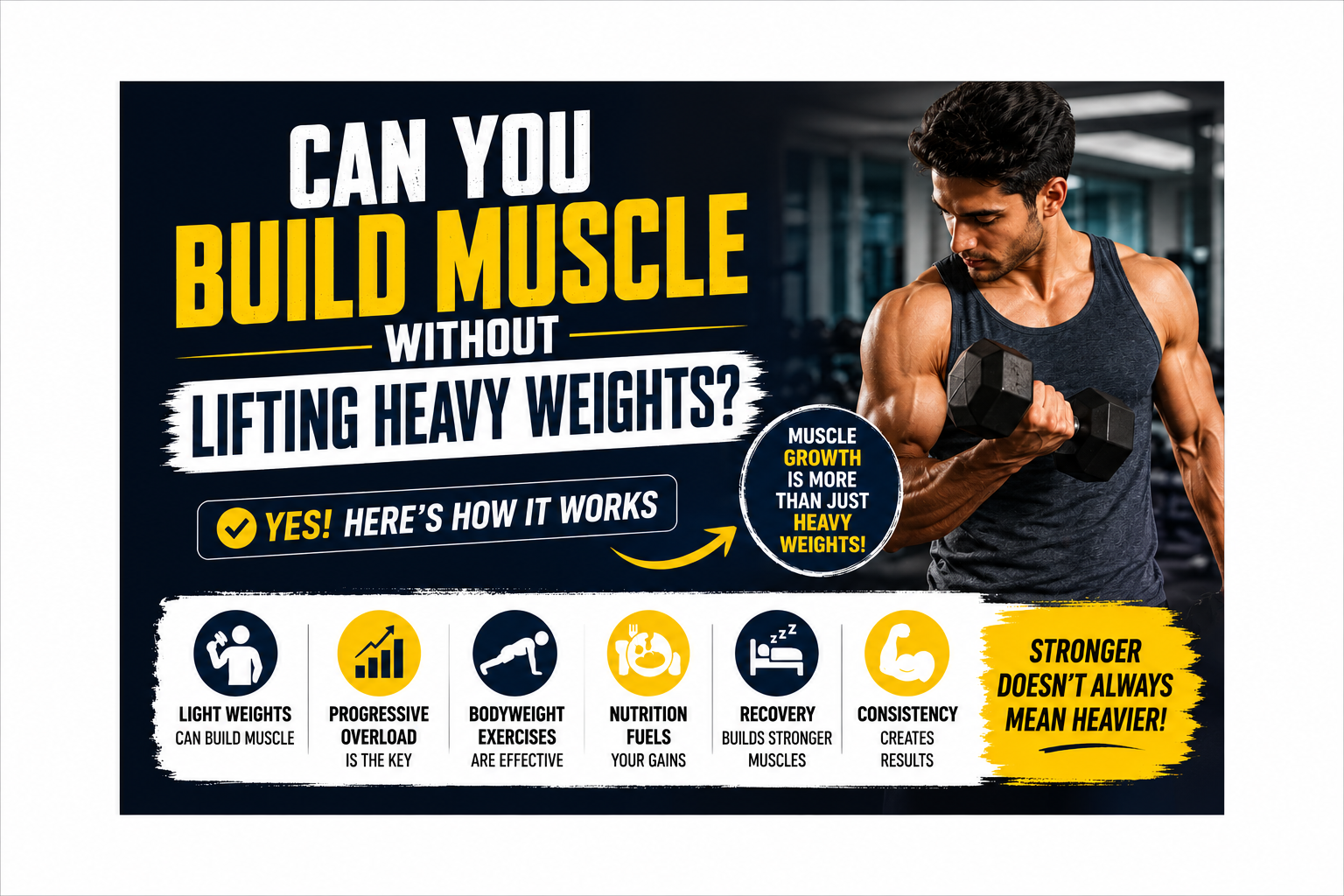
Many people believe that you need to lift very heavy weights to build muscle. This is a common idea in the gym, but it is not completely true.
You can build muscle without always lifting heavy weights. What matters is giving your muscles enough resistance and making your workouts challenging over time.
You can use moderate or even lighter weights and still support muscle growth when you perform the exercises with good technique, enough effort, and a proper workout plan.
Whether you are a beginner, returning to the gym, or simply prefer lighter weights, there are several ways to make your strength training workout effective.
What Makes Muscles Grow?
Muscle growth is also called muscle hypertrophy. When you perform resistance exercises, your muscles work against a load. This creates a training stimulus that, along with proper nutrition and recovery, can help your muscles adapt and become stronger.
The load does not always have to be extremely heavy.
For example, you could perform an exercise with:
- Heavy weights and fewer repetitions
- Moderate weights and moderate repetitions
- Lighter weights and more repetitions
All of these can be useful when the exercise is challenging enough and performed properly.
The important thing is not simply how heavy the dumbbell is. Training quality, effort, consistency, progressive overload, nutrition, and recovery all matter.
Can Light Weights Build Muscle?
Yes, lighter weights can contribute to muscle growth when the set is challenging.
Imagine you normally perform biceps curls with a heavy weight for 8 repetitions. You could instead use a lighter weight and perform more controlled repetitions.
As the set becomes harder, your muscles have to keep working to complete the movement.
However, using very light weights that create almost no challenge is unlikely to provide the same training stimulus as a properly challenging resistance exercise.
The goal is to choose a weight that allows you to maintain proper exercise form while making the set sufficiently difficult.
Why You Don’t Need to Lift Heavy Every Workout
Heavy lifting can be useful, but it is not the only way to train.
Constantly lifting very heavy weights can also create more fatigue and may make it harder to maintain good technique, especially when you are tired.
Using moderate or lighter resistance can sometimes make it easier to focus on:
- Exercise technique
- Range of motion
- Muscle control
- Repetition quality
- Training consistency
This can be particularly useful for beginners who are still learning how to perform exercises correctly.
The Importance of Progressive Overload
If your goal is to build muscle without lifting heavy weights, progressive overload is still important.
Progressive overload means gradually increasing the challenge placed on your muscles.
You can increase the challenge by:
- Adding a small amount of weight
- Increasing repetitions
- Adding another set
- Improving your range of motion
- Using a more difficult exercise
- Improving your exercise technique
- Reducing rest in some appropriate exercises
For example, if you perform 10 repetitions with good form today, you may eventually be able to perform 12 repetitions with the same weight.
Later, you could increase the resistance slightly and work your way up again.
This creates a gradual training progression.
Repetitions and Muscle Growth
There is no single repetition number that everyone must follow to build muscle.
Different repetition ranges can be used in a resistance training program.
For example:
- Lower repetitions are often used with heavier resistance.
- Moderate repetitions are common in muscle-building workouts.
- Higher repetitions can be used with lighter resistance.
When using lighter weights, you may need to perform more repetitions to make the set challenging.
The most important thing is to choose a suitable resistance and perform the exercise with controlled technique.
Training Close to Failure
Another important concept is training close to failure.
Muscle failure means you cannot complete another repetition with proper form.
You do not need to reach complete failure on every set. However, stopping a set when you still have many easy repetitions left may not provide enough challenge for your muscles.
You can think about reps in reserve (RIR).
For example, if you finish a set and feel that you could have performed only two more good repetitions, you were around 2 RIR.
This can be a useful way to manage workout intensity without taking every set to complete failure.
Exercises You Can Use
You can build an effective muscle-building routine using many different exercises.
Upper Body
Examples include:
- Push-ups
- Dumbbell chest press
- Shoulder press
- Lateral raises
- Dumbbell rows
- Biceps curls
- Triceps extensions
Lower Body
You can also use:
- Squats
- Lunges
- Step-ups
- Leg presses
- Leg extensions
- Hamstring curls
- Calf raises
Bodyweight exercises can also provide resistance.
For example, push-ups, squats, lunges, and other bodyweight exercises can become more challenging by increasing repetitions, changing variations, or improving control.
Proper Form Is More Important Than Heavy Weight
One of the biggest mistakes beginners make is trying to lift more weight than they can control.
Heavy weights are not useful if you cannot perform the exercise correctly.
Proper exercise form helps you perform the movement safely and effectively.
Focus on:
- Controlled movement
- Good posture
- Suitable range of motion
- Stable body position
- Correct breathing
- Appropriate resistance
If you have to swing, jerk, or change your body position to complete a repetition, the weight may be too heavy for your current ability.
Nutrition Also Matters
Exercise is only one part of building muscle.
Your body needs enough energy and nutrients to support training and recovery.
A balanced diet should include:
- Protein-rich foods
- Carbohydrates
- Healthy fats
- Fruits and vegetables
- Enough fluids
Protein for muscle growth is especially important because protein provides amino acids that help support muscle repair and adaptation.
Good food choices can include eggs, dairy products, fish, lean meats, beans, lentils, tofu, nuts, and other protein-rich foods.
Your exact nutritional needs depend on your body, activity level, goals, and overall diet.
Don’t Forget Recovery
Your muscles need time to recover after resistance training.
Recovery includes:
- Getting enough sleep
- Eating a balanced diet
- Staying hydrated
- Taking appropriate rest days
- Managing training volume
- Avoiding excessive fatigue
If you train hard every day without enough recovery, your workout performance may suffer.
A good muscle recovery routine allows you to return to your workouts with better energy and performance.
Who Can Benefit From Lighter Weights?
Lighter or moderate weights can be useful for many people.
They may be especially helpful for:
- Beginners
- People learning exercise technique
- People returning after a long break
- People who prefer higher-repetition workouts
- People looking for variety in their training
- People who want to reduce unnecessary training fatigue
However, the right training approach depends on your fitness level and goals.
If you have an injury or medical condition, speak with an appropriate healthcare professional before starting or changing an exercise program.
Can You Build Muscle With Bodyweight Exercises?
Yes, bodyweight exercises can provide resistance and can be part of a muscle-building program.
Exercises such as push-ups, squats, lunges, pull-ups, and dips can become challenging as you improve.
The key is progression.
For example, a beginner may start with regular squats. As they become stronger, they could increase repetitions or move to a more challenging variation.
Bodyweight training can therefore be a useful part of strength training and muscle development.
Heavy Weights vs Light Weights
So, which is better?
The answer depends on the exercise, your experience, and your goal.
Heavy weights can be useful when you want to develop strength and handle higher resistance.
Lighter weights can also support muscle growth when the exercise is challenging and performed with enough effort.
Instead of asking, “How heavy should I lift?”, also ask:
- Can I perform the exercise correctly?
- Is the set challenging?
- Am I gradually improving?
- Am I recovering properly?
- Am I following a consistent workout routine?
These questions can help you create a better approach to muscle building.
Final Thoughts
You can build muscle without lifting extremely heavy weights.
Heavy resistance is one tool for building strength and muscle, but it is not the only tool. Moderate and lighter weights can also be effective when you use enough effort, maintain proper form, and gradually increase the challenge.
A successful muscle-building plan combines resistance training, progressive overload, proper exercise technique, adequate protein, balanced nutrition, recovery, and consistency.
The best workout is not necessarily the one where you lift the heaviest weight. It is the one that you can perform correctly, recover from, and continue progressing with over time.
Frequently Asked Questions
1. Can you build muscle without lifting heavy weights?
Yes. You can build muscle using moderate or lighter weights when the exercises are challenging enough and you train consistently with proper technique and progressive overload.
2. Are light weights good for muscle growth?
Yes. Light weights can support muscle growth when they provide enough resistance and the set is performed with sufficient effort.
3. Do I need to train to failure to build muscle?
No. You do not need to reach complete muscle failure on every set. Training close to failure can provide a strong training stimulus while helping you manage fatigue.
4. How many repetitions should I do to build muscle?
There is no single repetition range that works for everyone. Different repetition ranges can be effective when the resistance and effort are appropriate.
5. Can bodyweight exercises build muscle?
Yes. Bodyweight exercises such as push-ups, squats, lunges, pull-ups, and dips can provide resistance and support muscle development when they are challenging and progressively performed.
6. Is progressive overload necessary for muscle growth?
Progressive overload is an important part of long-term muscle growth. You can increase the challenge by adding weight, repetitions, sets, exercise difficulty, or improving movement quality.
7. Is heavy lifting better for strength?
Heavy resistance can be very useful for developing strength, but strength also depends on technique, training consistency, exercise selection, recovery, and a structured strength training program.
8. Can beginners build muscle with light weights?
Yes. Beginners can start with manageable weights and focus on proper form, controlled repetitions, consistency, and gradual progression.
9. What should I eat to build muscle?
A balanced diet with adequate protein, carbohydrates, healthy fats, vitamins, minerals, and fluids can support muscle growth and recovery. Individual nutrition needs vary.
10. How important is recovery for muscle growth?
Recovery is very important. Sleep, nutrition, hydration, rest, and appropriate training volume help your body recover and adapt to resistance training.
Leave a Reply