
Starting a new workout routine can leave your muscles feeling sore. You may feel stiffness, tenderness, or discomfort a day or two after exercise. This is common, especially after trying a new exercise, increasing your workout intensity, or returning to the gym after a break.
However, not every type of discomfort after exercise is normal. Muscle soreness and exercise-related pain are different, and knowing the difference can help you understand when to continue training and when to take a break.
Another common concern after starting exercise is weight fluctuation after exercise. Your body weight can change from day to day because of water, food, glycogen, and other normal factors. It does not always mean that you have gained or lost body fat.
Let’s understand both topics in simple terms.
What Is Muscle Soreness After Exercise?
Muscle soreness is often called Delayed Onset Muscle Soreness (DOMS). It commonly develops several hours after exercise and can feel strongest around one to three days later.
You may experience:
- Muscle stiffness
- Mild tenderness
- A feeling of tightness
- Difficulty moving the muscle comfortably
- Mild discomfort when using the affected muscle
DOMS is particularly common when you:
- Start a new workout
- Increase your workout volume
- Try a new exercise
- Increase resistance or weights
- Perform more repetitions than usual
- Return to exercise after a long break
For many people, normal muscle soreness gradually improves as the body recovers.
What Does Exercise-Related Pain Feel Like?
Pain caused by an injury can feel different from normal muscle soreness.
It may be:
- Sharp
- Sudden
- Severe
- Localized to one specific area
- Associated with swelling or bruising
- Getting worse instead of better
For example, feeling general soreness in your legs after a challenging leg workout can be normal. But sudden, sharp pain in your knee during a squat may indicate that something is wrong.
This is why it is important to pay attention to where the discomfort is, when it started, and how it changes over time.
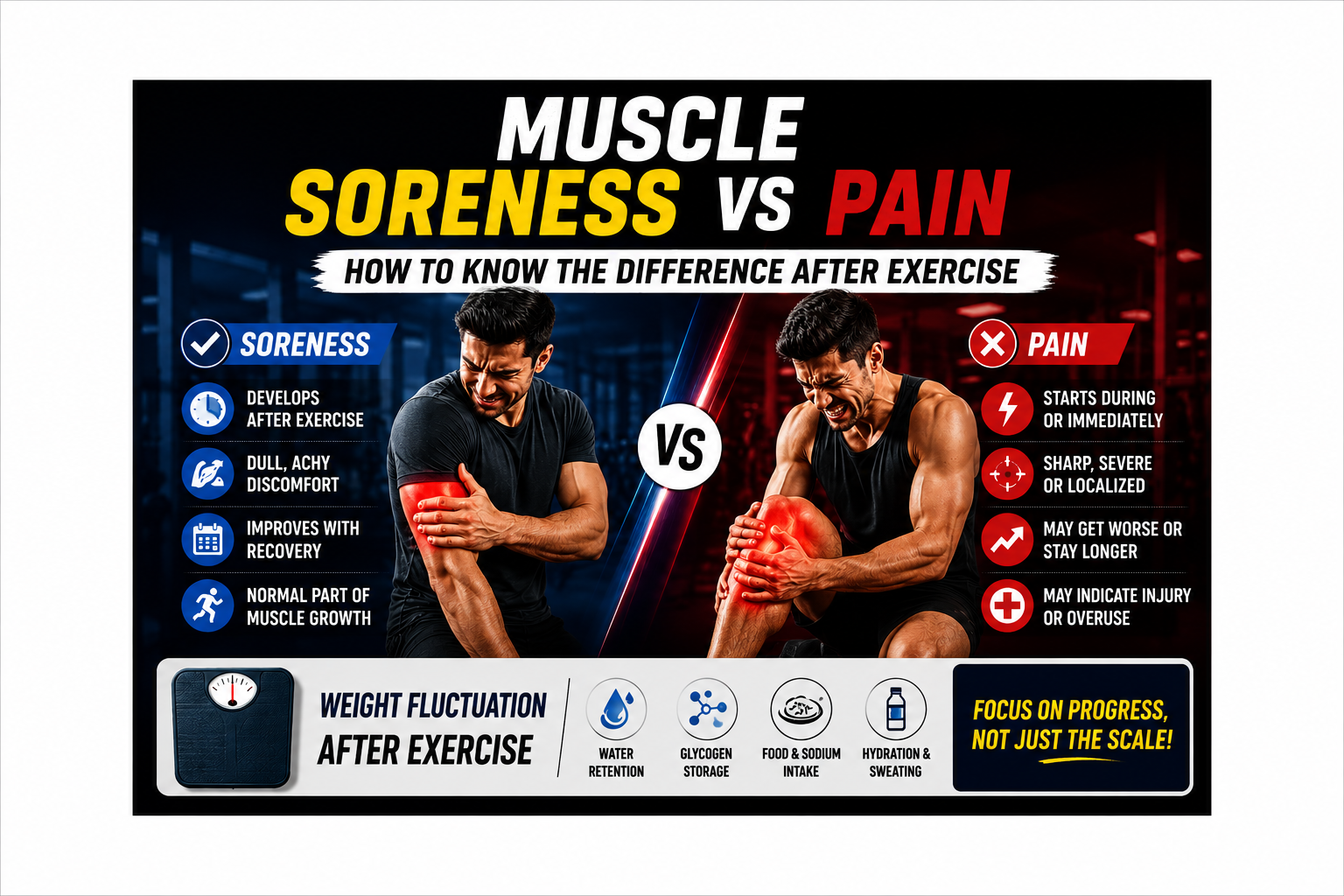
Muscle Soreness vs Pain: What’s the Difference?
A simple way to understand the difference is to look at the type and timing of discomfort.
| Muscle Soreness | Possible Exercise-Related Pain |
|---|---|
| Usually develops after exercise | May start during or immediately after exercise |
| Often affects muscles used during training | May be focused around a joint or specific area |
| Usually feels dull or tender | Can feel sharp, stabbing, or severe |
| Often improves with recovery | May continue or become worse |
| Common after a new workout | Can occur after an injury or poor movement |
| Usually temporary | May require professional assessment |
This table is only a general guide. If you are unsure about unusual or severe pain, consider speaking with an appropriate healthcare professional.
Why Do Muscles Become Sore After a Workout?
When you perform resistance training or another challenging form of exercise, your muscles experience stress.
A new or harder workout can create temporary muscle damage and inflammation. Your body then works to repair and adapt to the training.
This process is part of exercise recovery.
Over time, regular training can make your body better adapted to certain exercises, so the same workout may cause less soreness.
Remember, muscle soreness is not a measurement of workout quality. You do not need to feel extremely sore after every workout to make progress.
Should You Exercise When You Are Sore?
It depends on how sore you are and what type of workout you plan to do.
If you have mild muscle soreness, you may still be able to perform light activity or train another muscle group.
For example, if your legs are mildly sore after a leg workout, you might perform an upper-body workout while allowing your legs to recover.
However, if you have significant pain, reduced movement, swelling, or symptoms that feel unusual, it is better to stop and seek appropriate advice rather than trying to push through it.
How Can You Reduce Muscle Soreness?
You cannot always prevent DOMS, but several habits can support muscle recovery.
1. Start Slowly
If you are new to exercise, avoid doing too much too soon. Gradually increase your training load and workout volume.
2. Warm Up
A suitable warm-up can prepare your body for exercise and help you move more comfortably.
3. Stay Hydrated
Drinking enough fluids throughout the day supports normal body function and exercise performance.
4. Eat a Balanced Diet
Your body needs enough energy and nutrients to support training and recovery. Include sources of protein, carbohydrates, healthy fats, fruits, vegetables, and other nutritious foods.
5. Get Enough Sleep
Sleep is an important part of workout recovery. Your body needs adequate rest after challenging exercise.
6. Keep Moving
Light movement can sometimes help you feel less stiff. Walking, gentle mobility exercises, or other low-intensity activities may be suitable when you have mild soreness.
What Is Weight Fluctuation After Exercise?
Many people become concerned when the weighing scale shows a different number after they start exercising.
Weight fluctuation after exercise is normal.
Your body weight can change from one day to another because of:
- Water retention
- Food and fluid intake
- Sodium intake
- Carbohydrate intake
- Glycogen storage
- Exercise-related inflammation
- Bowel movements
- Sweating and hydration
- Changes in workout routine
For example, after a hard workout, your body may temporarily hold more water as part of the recovery process. This can cause the number on the scale to increase even though you have not gained body fat.
Why Does Weight Increase After a Workout?
A temporary increase in body weight does not automatically mean fat gain.
When you exercise regularly, your muscles store glycogen, which is used as an energy source during physical activity. Glycogen is stored along with water, so changes in glycogen levels can affect your body weight.
A hard workout can also cause temporary inflammation as your muscles recover. This may contribute to short-term changes in water weight.
This is why looking at your weight over several weeks can be more useful than worrying about one day’s measurement.
Why Does Weight Drop After Exercise?
You may also notice that your weight is lower immediately after a workout.
This is often because you have lost water through sweat.
Once you drink fluids and replace what your body has lost, your weight may return closer to its previous level.
This is why post-workout weight should not be treated as a direct measurement of fat loss.
How Should You Track Your Fitness Progress?
If your goal is weight loss, muscle gain, or improved fitness, don’t rely only on the weighing scale.
You can also track:
- Strength gains
- Workout performance
- Body measurements
- Progress photos
- Fitness levels
- Repetitions and weights
- How your clothes fit
- Energy levels
- Workout consistency
For example, your weight may stay similar while you become stronger and build muscle. This can still represent positive progress.
When Should You Stop Exercising?
You should not ignore serious or unusual symptoms during or after exercise.
Stop exercising and consider seeking professional medical advice if you experience symptoms such as severe or persistent pain, significant swelling, major loss of movement, chest pain, fainting, difficulty breathing, or other concerning symptoms.
The important point is to avoid assuming that every type of pain is simply post-workout soreness.
How Can a Personal Trainer Help?
A qualified personal trainer can help you learn proper exercise technique, choose suitable weights, structure your workout program, and gradually increase training intensity.
Good form is particularly important when performing exercises such as squats, deadlifts, presses, rows, and other resistance exercises.
A trainer can also help you understand the difference between a challenging workout and unnecessarily pushing yourself too hard.
However, a personal trainer is not a substitute for medical diagnosis or treatment when you have an injury or concerning symptoms.
Final Thoughts
Understanding muscle soreness vs pain can help you make better decisions about your workouts. Mild muscle soreness after a new or challenging workout is common, but sharp, severe, persistent, or unusual pain should not simply be ignored.
At the same time, don’t become worried about every change on the weighing scale. Weight fluctuation after exercise is normal and can be caused by water, glycogen, food, hydration, and exercise-related changes.
Focus on your overall fitness progress rather than one workout or one day’s weight. With consistent strength training, proper exercise form, balanced nutrition, hydration, sleep, and recovery, you can build healthier long-term fitness habits.
Frequently Asked Questions
1. How can I tell the difference between muscle soreness and injury pain?
Normal muscle soreness is often a dull, tender, or stiff feeling that develops after exercise. Injury-related pain may be sharp, sudden, severe, localized, or associated with swelling or reduced movement.
2. What is DOMS?
DOMS stands for Delayed Onset Muscle Soreness. It commonly occurs after a new or challenging workout and can develop hours after exercise and last for several days.
3. Is it normal to feel sore after every workout?
Not necessarily. Muscle soreness can happen after challenging or unfamiliar exercise, but you do not need to be sore after every workout to build muscle or improve fitness.
4. Can I work out when my muscles are sore?
If the soreness is mild, light activity or training another muscle group may be possible. If you have significant pain or difficulty moving, allow more recovery and consider getting professional advice.
5. Why does my weight increase after exercise?
Weight fluctuation after exercise can happen because of water retention, glycogen storage, food intake, hydration, and temporary changes related to muscle recovery. A short-term increase does not automatically mean fat gain.
6. Why does my weight drop immediately after a workout?
Your weight may temporarily drop because you lose water through sweating. Once you drink fluids, your weight can return to its normal range.
7. Does muscle soreness mean I had a good workout?
No. Soreness is not a reliable measure of workout quality. You can make progress without becoming very sore after every workout.
8. How can I support muscle recovery after exercise?
Adequate sleep, hydration, balanced nutrition, sufficient protein, appropriate rest, and a well-planned workout routine can support exercise recovery and muscle recovery.
9. When should I see a doctor for exercise pain?
If you experience severe, persistent, or unusual pain, significant swelling, major movement problems, chest pain, difficulty breathing, fainting, or other concerning symptoms, seek appropriate medical attention.
Leave a Reply