
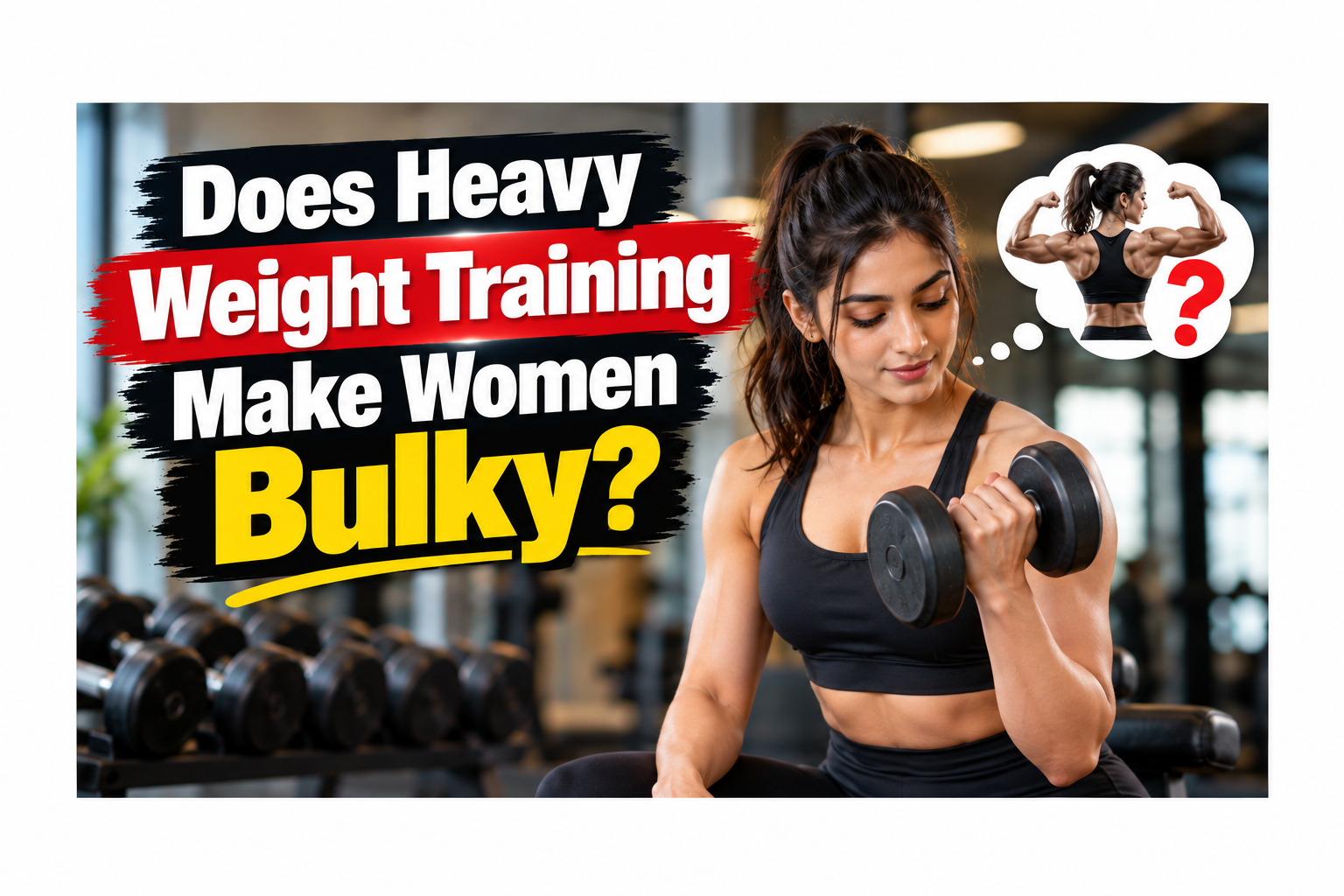
Many women avoid heavy weight training because they think it will make them look too muscular or “bulky.” This is one of the most common myths about women and strength training.
The truth is simple: lifting weights does not automatically make women bulky.
Weight training can help women build stronger muscles, improve body shape, increase strength, support fat loss and improve overall fitness. How much muscle you build depends on your training, diet, genetics, hormones and overall calorie intake.
If your goal is to look fit, toned and strong, strength training can be one of the best tools in your workout routine.
What Does “Bulky” Actually Mean?
The word “bulky” means having a large amount of muscle mass.
Building a significant amount of muscle does not happen overnight. It usually requires months or years of consistent resistance training, proper nutrition and enough calories to support muscle growth.
Most women who start weight training will not suddenly become very muscular.
Instead, they may notice:
- Better muscle definition
- Stronger legs and arms
- Firmer muscles
- Better body shape
- Improved posture
- Increased strength
- Better workout performance
So, if you are worried that picking up heavier dumbbells will suddenly make you look like a professional bodybuilder, you do not need to worry.
Why Don’t Women Build Muscle as Easily as Men?
One important reason is hormones.
Men generally have much higher levels of testosterone than women. Testosterone plays an important role in muscle growth.
Women can absolutely build muscle, but the rate and amount of muscle growth are usually different.
This is one reason why a woman who starts lifting weights is unlikely to suddenly develop a very large muscular body.
Of course, women can build significant muscle if that is their goal. Female bodybuilders and athletes train specifically for muscle development and follow structured training and nutrition plans.
But simply doing regular strength training does not automatically produce that level of muscularity.
Can Heavy Weights Help Women Get Toned?
Yes.
“Getting toned” is not a special type of muscle. It generally means having enough muscle along with a lower level of body fat so that the muscles are more visible.
Strength training helps you build and maintain muscle.
Fat loss comes mainly from maintaining an appropriate calorie deficit over time.
This means a combination of:
Strength Training + Good Nutrition + Enough Protein + Regular Activity = Better Body Composition
For example, if a woman wants more defined arms, simply doing endless cardio may not be the best approach.
A better routine may include:
- Shoulder exercises
- Rows
- Chest presses
- Biceps curls
- Triceps exercises
- Squats
- Lunges
- Regular cardio
- A balanced diet
The goal is not simply to lose weight. The goal can be to improve body composition.
Why Should Women Lift Heavy Weights?
Heavy is a relative term.
What feels heavy for one person may be easy for another.
You do not need to lift extremely heavy weights. You should choose a weight that allows you to perform the exercise with good technique while making the final repetitions challenging.
Regular resistance training can provide many benefits.
1. It Builds Strength
One of the biggest benefits of weight training is becoming stronger.
You may find it easier to:
- Carry shopping bags
- Climb stairs
- Pick up objects
- Perform daily activities
- Participate in sports
Strength is useful outside the gym too.
2. It Helps Build Muscle
Resistance training gives your muscles a reason to adapt.
Over time, consistent training can help increase muscle size and strength.
3. It Supports Fat Loss
Building and maintaining muscle can help improve body composition.
However, remember that fat loss mainly depends on your overall energy balance. Weight training alone does not guarantee fat loss.
4. It Can Improve Body Shape
Muscle development can change how your body looks.
For example, strength training can help develop:
- Glutes
- Legs
- Shoulders
- Back
- Arms
- Core
This can create a stronger and more athletic appearance.
5. It Can Improve Confidence
Getting stronger can be very motivating.
Seeing yourself progress from a 5 kg dumbbell to a 7.5 kg or 10 kg dumbbell can give you a clear sign that your body is becoming stronger.
Does Lifting Heavy Weights Make Women Lose Their Feminine Shape?
No.
Strength training does not automatically remove a woman’s feminine appearance.
Your body shape is influenced by genetics, bone structure, muscle distribution, body fat and many other factors.
You can design your training according to your goals.
For example, if your goal is to build stronger glutes and legs, your program can include:
- Squats
- Hip thrusts
- Romanian deadlifts
- Lunges
- Leg presses
- Glute-focused exercises
If your goal is overall fitness, you can train your entire body.
There is no single “female” way to lift weights.
Can Women Lift the Same Exercises as Men?
Yes.
Women can perform the same basic strength exercises, provided they are appropriate for their fitness level and performed with proper technique.
These can include:
- Squats
- Deadlifts
- Bench press
- Shoulder press
- Rows
- Pull-downs
- Lunges
- Hip thrusts
- Leg press
The difference is usually not the exercise itself. The difference is the weight, repetitions, training volume and individual goal.
A beginner should not copy the weight used by an experienced lifter.
Start at your own level and gradually increase the challenge.
What Is Progressive Overload?
Progressive overload means gradually making your training more challenging.
For example, you might start with:
Squat – 10 kg
After several weeks, you may be able to perform:
Squat – 15 kg
Later, you may progress to:
Squat – 20 kg
This does not mean you have to increase the weight every workout.
You can also progress by:
- Doing more repetitions
- Improving exercise technique
- Increasing training volume
- Using a better range of motion
- Controlling the movement better
- Increasing resistance gradually
Progressive overload is an important part of strength training and muscle growth.
How Heavy Should Women Lift?
There is no single weight that is correct for every woman.
The right weight depends on:
- Age
- Training experience
- Exercise
- Strength level
- Fitness goal
- Injury history
- Exercise technique
A good starting point is a weight that allows you to complete your planned repetitions with good form while making the final repetitions challenging.
For beginners, technique should come before heavy weight.
Once your technique is comfortable, you can slowly increase resistance.
Will Women Gain Weight From Weight Training?
The number on the weighing scale may change for many reasons.
If you start resistance training, your body can become stronger and your muscle mass may increase.
At the same time, you may lose body fat.
This means your body can look different even if your scale weight does not change much.
For this reason, do not measure your progress only by body weight.
Also look at:
- Waist measurement
- Body measurements
- Strength
- Fitness level
- Progress photos
- How your clothes fit
- Workout performance
These can give you a better idea of your progress.
Heavy Weights vs Light Weights for Women
Both light and heavy weights can be useful.
The important thing is that the resistance is appropriate for your goal and challenging enough.
For muscle growth, different resistance levels can work when the sets are sufficiently challenging and training is properly structured.
You do not have to use extremely heavy weights to build muscle.
For example, dumbbells can be useful for:
- Shoulder exercises
- Arm exercises
- Lunges
- Squats
- Rows
Machines can also be excellent for beginners because they can provide stability while you learn movement patterns.
Should Women Do Cardio Instead of Weight Training?
Cardio and strength training have different benefits.
You do not necessarily need to choose one.
A balanced fitness routine can include both.
Strength Training
Useful for:
- Muscle strength
- Muscle development
- Body composition
- Functional strength
- Exercise performance
Cardio
Useful for:
- Cardiovascular fitness
- Endurance
- Increasing physical activity
- Supporting calorie expenditure
A combination of resistance training and cardio can work very well for general fitness and fat loss.
What Should Women Eat When Lifting Weights?
Nutrition plays an important role in your results.
If you are doing strength training, make sure your diet contains enough:
- Protein
- Carbohydrates
- Healthy fats
- Fruits
- Vegetables
- Whole grains
- Fluids
Protein is especially important because it provides amino acids needed for muscle repair and growth.
Good protein choices include:
- Eggs
- Paneer
- Greek yogurt
- Milk
- Curd
- Chicken
- Fish
- Tofu
- Soy
- Dal
- Beans
You do not need an extreme diet.
A balanced diet that supports your goal is usually a better approach.
Common Mistakes Women Make With Weight Training
1. Being Afraid of Heavy Weights
Many women stay with very light weights because they are afraid of getting bulky.
This can limit strength progress.
2. Doing Only Cardio
Cardio is useful, but strength training should not be ignored if you want stronger and more defined muscles.
3. Changing the Workout Every Week
Your body needs time to adapt.
Follow a structured workout plan and track your progress.
4. Ignoring Protein
A low-protein diet can make it harder to support muscle growth and recovery.
5. Using Poor Technique
Lifting heavier is not useful if your form is poor.
Learn the movement first and increase weight gradually.
6. Comparing Yourself With Other Women
Every woman’s body responds differently to training.
Focus on your own progress.
How Women Can Start Weight Training Safely
If you are completely new to strength training, start with basic movements.
A beginner routine can include:
Lower Body
- Squats
- Leg press
- Lunges
Upper Body
- Chest press
- Lat pulldown
- Seated row
Core
- Plank
- Dead bug
- Controlled abdominal exercises
Start with manageable resistance and focus on proper form.
If you are unsure about exercise technique, working with a qualified trainer can be helpful.
Final Thoughts
So, does heavy weight training make women bulky?
No, not automatically.
Strength training can help women become stronger, build lean muscle, improve body composition and feel more confident.
Becoming very muscular requires a specific combination of training, nutrition, genetics and long-term consistency. Simply lifting weights a few times a week will not suddenly make you bulky.
Instead of being afraid of weights, focus on getting stronger, improving your technique and following a consistent workout plan.
Your goal should not be to avoid muscle.
Your goal should be to build the right amount of strength and muscle for your own body and fitness goals.
FAQs
1. Will lifting heavy weights make women bulky?
No. Regular weight training does not automatically make women bulky. Muscle growth depends on training, nutrition, genetics, hormones and long-term consistency.
2. Should women lift heavy weights?
Yes, women can safely lift challenging weights when the exercises are suitable and performed with proper technique.
3. Can women build muscle without becoming bulky?
Yes. Women can build strength and muscle without developing a very large muscular appearance.
4. Is weight training better than cardio for women?
Neither is automatically better. Strength training and cardio provide different benefits, and combining both can create a balanced fitness routine.
5. How many days a week should women lift weights?
It depends on your fitness level and workout plan. Many people can benefit from strength training several times per week while allowing enough recovery between sessions.
6. Can weight training help women lose belly fat?
Strength training can support overall fat loss and improve body composition, but you cannot specifically choose where your body loses fat. Nutrition, activity and overall calorie balance also matter.
7. Can women get toned by lifting weights?
Yes. Building muscle while reducing excess body fat can create a more defined or “toned” appearance.
8. Do women need different exercises from men?
Not necessarily. Women can perform the same basic strength exercises. The resistance, volume and program should be adjusted to the individual’s ability and goals.
9. Will lifting weights make women gain weight?
Muscle gain can increase body weight, but weight changes depend on many factors. You can also lose fat while building or maintaining muscle, so the scale does not tell the whole story.
10. Should beginners start with heavy weights?
Beginners should first learn proper exercise technique. Once the movement is comfortable, resistance can gradually increase.
Leave a Reply