
When you go to the gym, you may focus on lifting weights, completing repetitions, and following your workout plan. But there is another important part of training that many people ignore: resting between sets.
Some people rest for only 20–30 seconds because they want to burn more calories. Others wait for two or three minutes before starting their next set. So, how long should you actually rest between sets?
The answer depends on your fitness goal, the exercise you are performing, the weight you are lifting, and your current fitness level.
If your goal is to build muscle, increase strength, improve endurance, or lose body fat, choosing the right rest time can help you get more from your workout.
In this guide, we will explain how long you should rest between sets, the best rest periods for different fitness goals, and common mistakes to avoid.
1. Why Is Rest Between Sets Important?
When you lift weights, your muscles use energy to complete each repetition. Your body also needs time to recover between sets so you can perform the next set properly.
Resting helps your body restore energy, manage fatigue, and maintain good exercise technique.
If you rest too little, you may struggle to complete your planned repetitions. Your lifting performance may decrease, especially during heavy exercises such as squats, deadlifts, and bench presses.
On the other hand, resting for too long may make your workout take more time than necessary, particularly when performing lighter exercises.
The goal is not to rest for the shortest possible time. The goal is to rest long enough to perform your next set safely and effectively.
2. How Long Should You Rest Between Sets?
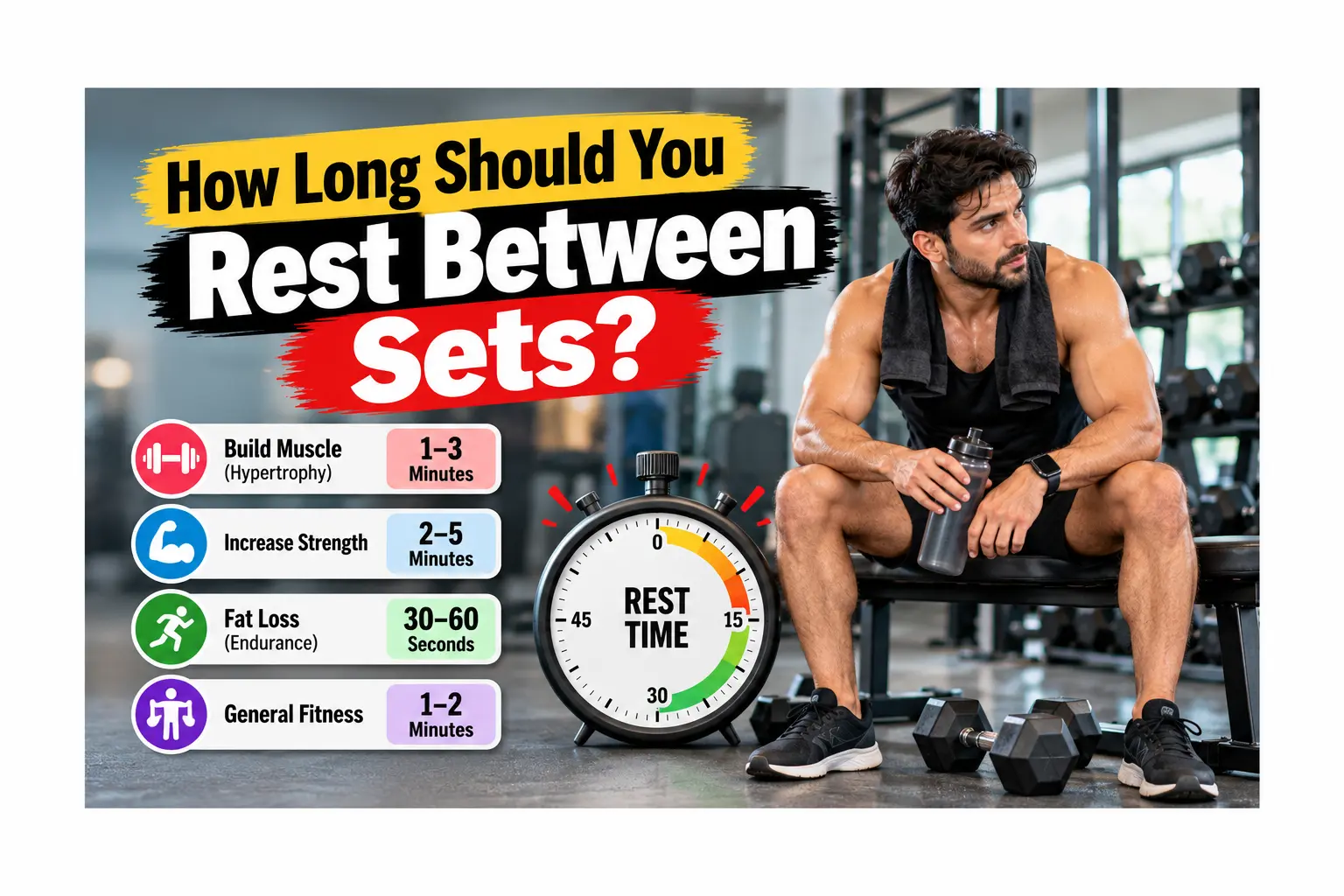
Your ideal rest time depends on what you want to achieve in the gym. Use these timings as a starting point.
| Fitness goal | Recommended rest time |
|---|---|
| Maximum strength | 2–5 minutes |
| Muscle growth | 1–3 minutes |
| Muscular endurance | 30–60 seconds |
| General fitness | 1–2 minutes |
| Heavy compound exercises | 2–5 minutes |
| Light isolation exercises | 45–90 seconds |
These are general guidelines, not strict rules. Your training experience, exercise difficulty, and recovery needs can change how much rest you need. Longer rest periods can help you maintain performance during demanding sets. Research suggests that resting longer than 60 seconds may offer a small benefit for muscle growth, although results vary.

PubMed Central (PMC)
+2
3. How Long Should You Rest for Muscle Growth?
If your main goal is to build muscle, resting for around 1–3 minutes between sets is a useful starting point.
Muscle growth, also called hypertrophy, depends on several factors, including training effort, workout volume, progressive overload, nutrition, and recovery.
For example, if you are doing dumbbell curls for three sets of 10 repetitions, you might rest for 60–90 seconds between sets.
However, if you are performing a difficult set of squats or bench presses, you may need two or three minutes before starting again.
Do not rush into the next set if your muscles are still very tired. If your performance drops sharply, take a little more rest.
Remember that shorter rest periods do not automatically mean faster muscle growth. Your priority should be completing good-quality sets with enough effort.
PubMed Central (PMC)
+1
4. How Long Should You Rest for Strength Training?
If your goal is to lift heavier weights and increase your strength, you will usually benefit from longer rest periods.
Rest for around 2–5 minutes between demanding sets. This gives your body more time to recover so you can lift heavy weights with better control.
For example, if you are performing heavy squats, deadlifts, or bench presses, resting for only 30 seconds may leave you too tired to perform the next set well.
A simple example:
- Set 1: 5 heavy squats
- Rest: 3 minutes
- Set 2: 5 heavy squats
- Rest: 3 minutes
- Set 3: 5 heavy squats
You may need more or less time depending on the weight and how difficult the sets feel.
If you are a beginner, focus on learning the correct technique before increasing the weight.
5. How Long Should You Rest for Fat Loss?
If you want to lose body fat, resting for around 30–90 seconds may work well for some lighter exercises and workout circuits.
However, you do not need to keep your rest periods extremely short to lose fat.
Fat loss mainly depends on maintaining a suitable calorie deficit over time. Strength training helps you maintain muscle while losing weight, and rest periods help you perform your exercises effectively.
For example, you could rest for 60–90 seconds between sets of dumbbell rows or machine exercises. For heavy squats or deadlifts, you may need two or more minutes.
Do not sacrifice good technique just to make your workout feel harder. Sweating more or feeling exhausted does not automatically mean you have burned more body fat.
6. How Long Should Beginners Rest Between Sets?
If you are new to the gym, start with around 1–2 minutes between most sets.
This gives you time to recover, check your technique, and prepare for the next set.
Here are some beginner-friendly examples:
- Bodyweight squats: 60–90 seconds
- Wall or bench push-ups: 60–90 seconds
- Lat pulldowns: 90–120 seconds
- Dumbbell curls: 60–90 seconds
- Leg press: 90–180 seconds, depending on effort
These times are flexible. If you are breathing heavily or cannot maintain proper form, rest longer.
As your fitness improves, you will learn how much recovery you need for different exercises.
7. What Happens If You Rest Too Little Between Sets?
Taking too little rest can make your workout more difficult than necessary.
You may notice:
- Fewer repetitions in the next set
- Reduced lifting performance
- Poorer exercise technique
- Greater tiredness during your workout
- Difficulty completing your planned sets
For example, if you can perform 12 repetitions of an exercise in your first set but only manage 6 in the next because you rested too briefly, you may benefit from a longer recovery period.
A short rest period is not always a problem. It becomes a problem when it stops you from training effectively or safely.
8. What Happens If You Rest Too Long Between Sets?
Longer rest periods are useful for heavy lifting, but excessive rest may make your workout unnecessarily long.
If you rest for five minutes after every light set of biceps curls, you may not need that much recovery.
Try to match your rest time to the exercise:
- Heavy compound lifts: longer rest
- Moderate-weight exercises: moderate rest
- Light isolation exercises: shorter rest
There is no need to hurry, but try to follow a consistent workout plan.
9. Should You Use Your Phone During Rest Periods?
Using your phone during rest periods is not necessarily bad. You can use it to track your workout, record weights, or set a timer.
However, scrolling through social media can make you lose track of time. You might end up resting for five minutes when you planned to rest for one minute.
A simple solution is to set a timer after each set. When it ends, check how you feel and start the next set if you are ready.
Use rest periods to relax, breathe normally, and prepare for your next exercise.
10. Practical Tips for Better Rest Between Sets
Follow these simple tips to improve your workout:
- Know your goal. Choose rest times according to strength, muscle growth, endurance, or general fitness.
- Use a timer. It helps you keep your rest periods consistent.
- Listen to your body. Take more time when an exercise feels especially demanding.
- Maintain good technique. Never rush a set when you are too tired to control the movement.
- Track your performance. Record your weights and repetitions to see whether you are improving.
- Stay hydrated. Drink water as needed during your workout.
- Be consistent. Good training habits matter more than following an exact rest time every day.
If you train at a gym such as Bodyzone Fitness & Spa in Sector 9C, Chandigarh, a qualified trainer can help you choose suitable rest periods for your workout plan and fitness level.
Conclusion
So, how long should you rest between sets? For most gym-goers, the answer is between 30 seconds and 5 minutes, depending on the exercise and fitness goal.
For muscle growth, try 1–3 minutes. For heavy strength training, rest for 2–5 minutes. For muscular endurance, shorter rest periods of around 30–60 seconds may be suitable.
The most important thing is to recover enough to perform your next set with good technique and effort. Do not rush simply because you think shorter rest means better results.
Choose a rest period that suits your goal, track your progress, and adjust it as your fitness improves.
Frequently Asked Questions (FAQs)
1. Is 30 seconds enough rest between sets?
Thirty seconds may be enough for some light exercises or endurance circuits. However, it may not be enough for heavy weight training or demanding compound exercises.
2. Is 1 minute of rest enough for muscle growth?
One minute can work for many exercises, especially lighter movements. If your repetitions or technique drop significantly, rest for 90 seconds or longer.
3. Should I rest 2 or 3 minutes between sets?
Both can be useful. Two minutes may be enough for moderate sets, while three minutes can help you recover from demanding exercises or heavier weights.
4. Does resting longer between sets build more muscle?
Not always. Longer rest can help you maintain repetitions and training quality. However, muscle growth also depends on training effort, total workout volume, nutrition, and recovery.
PubMed Central (PMC)
+1
5. Should I rest less between sets to lose belly fat?
No. Shorter rest periods do not specifically target belly fat. Fat loss depends mainly on overall energy balance, regular activity, and a sustainable diet.
6. How long should I rest between sets of squats?
For heavy squats, around 2–5 minutes may be appropriate. For lighter sets, 1–2 minutes may be enough if you recover well and maintain good technique.
7. How long should I rest between sets of biceps curls?
Around 60–90 seconds is a useful starting point. Rest longer if you are using heavier weights or cannot maintain the planned repetitions.
8. Is it bad to rest for 5 minutes between sets?
No. Five minutes can be appropriate for very heavy strength exercises. It may be unnecessary for many lighter exercises, depending on your goal.
9. Should beginners rest longer between sets?
Beginners should take enough time to recover, learn the correct technique, and feel ready for the next set. Around 1–2 minutes is a useful starting point for many exercises.
10. Should I wait until my breathing returns to normal before the next set?
For demanding exercises, allow your breathing to settle and make sure you can perform the next set safely. You do not need to feel completely fresh, but you should be sufficiently recovered to maintain good technique.
Leave a Reply