
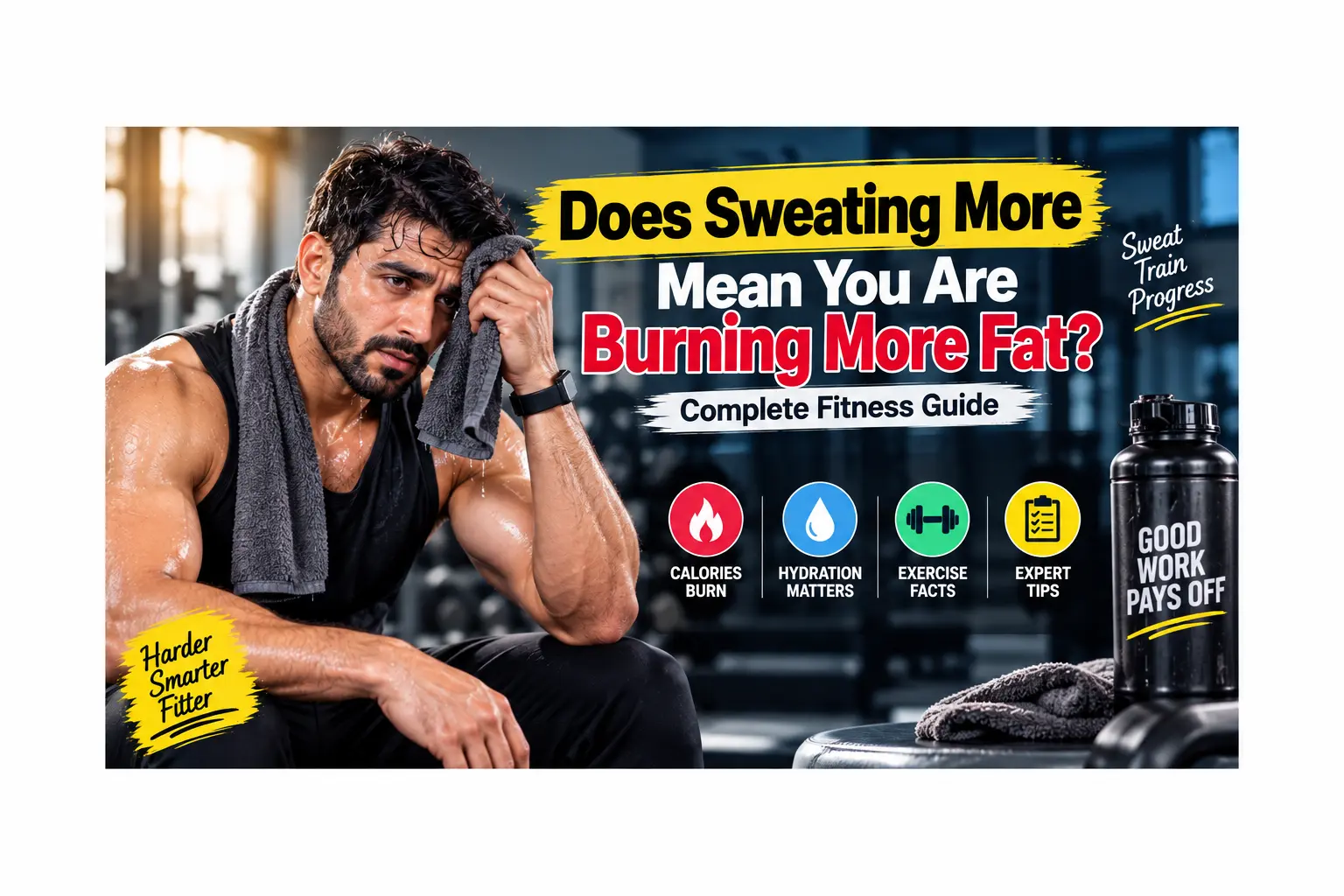
Many people finish a workout with a completely wet T-shirt and think, “I must have burned a lot of fat today.” On the other hand, someone who barely sweats may feel that their workout was not hard enough.
But sweat is not a fat-loss meter.
Sweating is mainly your body’s cooling system. When your body temperature rises during exercise, your sweat glands produce sweat. As the sweat evaporates, it helps remove heat from your body. How much you sweat can depend on the weather, humidity, clothing, body size, genetics, fitness level and exercise intensity.
As a fitness trainer with more than 10 years of experience, I often tell people: Don’t judge your workout by how wet your T-shirt is. Judge it by the quality and consistency of your training.
Let’s understand the difference between sweating, calorie burning and actual fat loss.
Does More Sweat Mean More Fat Burning?
No. Sweating more does not automatically mean you are burning more fat.
During exercise, your muscles need energy. The harder your muscles work, the more energy your body may use. Exercise can also increase body temperature, which causes sweating.
So, you may see both things happening at the same time:
Hard workout → more energy used → more heat → more sweating
But this does not mean:
More sweating → more fat burned
The sweat itself requires very little energy. Its main job is to cool your body.
For example, imagine two people doing the same 30-minute workout. One person may sweat heavily while the other barely sweats. That difference does not tell you who burned more fat.
Why Do Some People Sweat More Than Others?
There is no single “normal” amount of sweat for everyone.
You may sweat more because of:
- Hot weather
- High humidity
- Wearing heavy clothing
- Higher exercise intensity
- Your body size
- Genetics
- Fitness level
- Your body’s natural sweating pattern
- Certain foods or drinks
- Individual differences in temperature regulation
This is why comparing your sweat with another person in the gym is not useful.
You might see someone lifting weights with almost no sweat while another person is dripping after a short cardio session. Both can still have had productive workouts.
What Actually Causes Fat Loss?
Fat loss happens when your body uses more energy over time than you consume from food and drinks. This is commonly called a calorie deficit.
Your body stores energy in the form of body fat. When your energy needs are greater than the energy coming from your food, your body can use stored energy. Over time, this can lead to a reduction in body fat.
Exercise can help because it increases your energy expenditure.
But fat loss is not determined by how much you sweat during one workout.
Think about it this way:
Sweat = cooling
Exercise = energy expenditure
Consistent calorie deficit = key part of fat loss
These are related, but they are not the same thing.
Why Does Your Weight Drop After a Sweaty Workout?
This is where many people get confused.
You step on the weighing scale before training and see 80 kg.
After a hard workout, you weigh 79.3 kg.
You may think:
“I lost 700 grams of fat!”
That is very unlikely from one workout.
Most of that immediate difference is likely to be water loss through sweat.
Sweat contains mostly water along with electrolytes. Once you drink fluids and replace the water you lost, your body weight can move back toward its previous level.
This is why your weight can change quickly from morning to evening or before and after exercise.
Water loss is not the same as fat loss.
This is one of the most important things to understand if your goal is weight loss.
Does Sweating Burn Calories?
Your body does use energy while exercising, but sweating itself is not a significant calorie-burning activity.
For example, running, cycling, swimming, strength training and other physical activities require your muscles to work. That muscle activity uses energy.
Sweating happens because your body is trying to control its temperature.
Cleveland Clinic notes that people can burn calories without sweating heavily, and the amount of sweating is affected by several factors unrelated to calorie expenditure.
So don’t try to make yourself sweat more just to burn extra fat.
Does Exercising in Hot Weather Burn More Fat?
This is another common fitness myth.
Some people wear extra layers or exercise in very hot conditions because they believe more sweating means more fat loss.
That is not a smart fat-loss strategy.
Heat can make you sweat more, but the additional sweat mainly represents greater fluid loss. Exercising in excessive heat can also increase the risk of dehydration, heat cramps, heat exhaustion and heatstroke.
Your goal should be to train effectively and safely, not to become as sweaty as possible.
What About Sauna and Steam Rooms?
A sauna or steam room can make you sweat heavily.
After sitting in a sauna, the weighing scale may show a lower number. But this is mainly because you have lost water.
Once you rehydrate, that weight can return.
Saunas should not be used as a replacement for exercise or a fat-loss program. Cleveland Clinic also notes that sauna-related short-term weight loss is primarily water loss rather than sustained fat loss.
Can You Burn Fat Without Sweating?
Absolutely.
You can burn calories and support fat loss without producing a lot of sweat.
For example, walking in a cool environment may not make you very sweaty, but it still requires energy.
Strength training can also be useful for body composition even when you don’t finish every workout completely soaked.
Your workout does not need to leave you dripping with sweat to be effective.
What Should You Focus on Instead of Sweat?
If your goal is fat loss, focus on these five things.
1. Consistent Exercise
Train regularly instead of looking for one extremely sweaty workout.
A sustainable routine is much more useful than exercising very hard once and then taking several days off.
2. Strength Training
Strength training helps you build and maintain muscle while you work toward your body-composition goals.
Use progressive overload by gradually improving your weights, repetitions, sets or exercise performance.
3. Cardio
Walking, cycling, running, swimming, spinning and other cardio activities can help increase your overall physical activity and energy expenditure.
Choose something you can perform consistently.
4. Nutrition
You cannot simply sweat away an unhealthy diet.
Pay attention to your overall calorie intake, protein, vegetables, fruits, whole foods and portion sizes.
Protein is also useful during fat loss because it can help with fullness and support muscle maintenance.
5. Recovery and Hydration
If you sweat heavily, replace the fluids you lose.
Do not purposely avoid water just to keep your post-workout weight lower.
Good hydration helps your body regulate temperature and supports normal exercise performance.
How to Know If Your Fat-Loss Program Is Working
Don’t use sweat as your progress measurement.
Instead, track:
- Body weight trends over several weeks
- Waist measurement
- Progress photos
- Strength in the gym
- Workout consistency
- How your clothes fit
- Daily activity
- Nutrition consistency
Your body weight can move up and down because of water, food, glycogen and other normal factors. Looking at the longer-term trend gives you a much better picture than checking your weight immediately after a sweaty workout.
A Simple Example
Suppose you do two workouts.
Workout A:
30 minutes of walking in an air-conditioned gym. You sweat very little.
Workout B:
30 minutes of exercise in a hot and humid environment. You sweat heavily.
It would be incorrect to say Workout B automatically burned more fat simply because you sweated more.
The actual energy cost of the exercise depends on factors such as the activity, intensity, duration and your individual characteristics. Sweat mainly tells you that your body is working to control its temperature.
Can You Use Sweat to Judge Workout Intensity?
Not accurately.
Sweat can be one normal response to exercise, but it is not a reliable measurement of workout quality.
Instead, look at:
- Exercise intensity
- Heart rate when appropriate
- Repetitions and sets
- Running or cycling pace
- Resistance used
- Rest periods
- Exercise technique
- Overall workout performance
For strength training, being able to gradually improve your performance is more useful than trying to produce maximum sweat.
What I Tell My Personal Training Clients
After more than 10 years in fitness training, one of the biggest mistakes I see is people chasing sweat instead of progress.
They may add extra layers, spend unnecessary time in the sauna or choose workouts simply because they make them sweat heavily.
Instead, build a structured plan.
If your goal is fat loss, combine sensible nutrition with strength training, cardio or daily activity, adequate recovery and consistency.
At Bodyzone Fitness & Spa in Chandigarh, personal training can be structured around individual goals such as fat loss, muscle gain, strength and body transformation. Customized training can also help you understand how to balance resistance training and cardio rather than simply chasing sweat.
Bodyzone Personal Training in Chandigarh
Final Takeaway
Sweating more does not mean you are burning more fat.
Sweat is primarily your body’s natural cooling system. A sweaty workout can certainly be a good workout, but sweat alone cannot tell you how much fat you have burned.
For long-term fat loss, focus on consistent exercise, strength training, cardio, sensible nutrition, adequate hydration and recovery.
Don’t chase the sweat.
Chase progress.
FAQs
1. Does sweating mean I am burning fat?
Not necessarily. Sweating mainly helps your body cool itself. Fat loss depends on your overall energy balance and consistent habits over time.
2. Do you burn more calories if you sweat more?
No. Sweating more does not automatically mean you are burning more calories. Exercise intensity, duration and the type of activity are more important factors.
3. Why do I lose weight after sweating?
The immediate drop is usually mostly water loss. Drinking fluids can restore some of that weight.
4. Does sweating burn belly fat?
No. Sweating does not specifically burn belly fat. Overall fat loss happens gradually through a suitable nutrition and exercise plan.
5. Is it good to sweat during a workout?
Sweating is a normal and useful cooling response during exercise. However, you do not need to sweat heavily for a workout to be effective.
6. Does running make you lose more fat because you sweat more?
Not necessarily. Running can use significant energy, but the amount you sweat is not a reliable measure of how much fat you burn.
7. Does sauna sweating help with fat loss?
A sauna can cause temporary water loss through sweating, but this should not be confused with meaningful fat loss.
8. Can I lose fat without sweating?
Yes. Walking, strength training and other activities can contribute to energy expenditure even when you sweat very little.
9. Should I wear extra clothes to sweat more?
No. Wearing excessive clothing to force sweating can increase dehydration and heat-related risks without providing a reliable fat-loss advantage.
10. What is more important than sweating for fat loss?
Focus on consistent training, appropriate nutrition, sufficient protein, daily activity, sleep, recovery and a sustainable calorie deficit.
11. Should I weigh myself after a sweaty workout?
It is better to look at weight trends rather than a single post-workout measurement. Your weight immediately after exercise can be temporarily lower because of fluid loss.
12. How can I track fat-loss progress?
Use several measures together: weekly weight trends, waist measurements, progress photos, clothing fit, strength and workout consistency.
Leave a Reply