
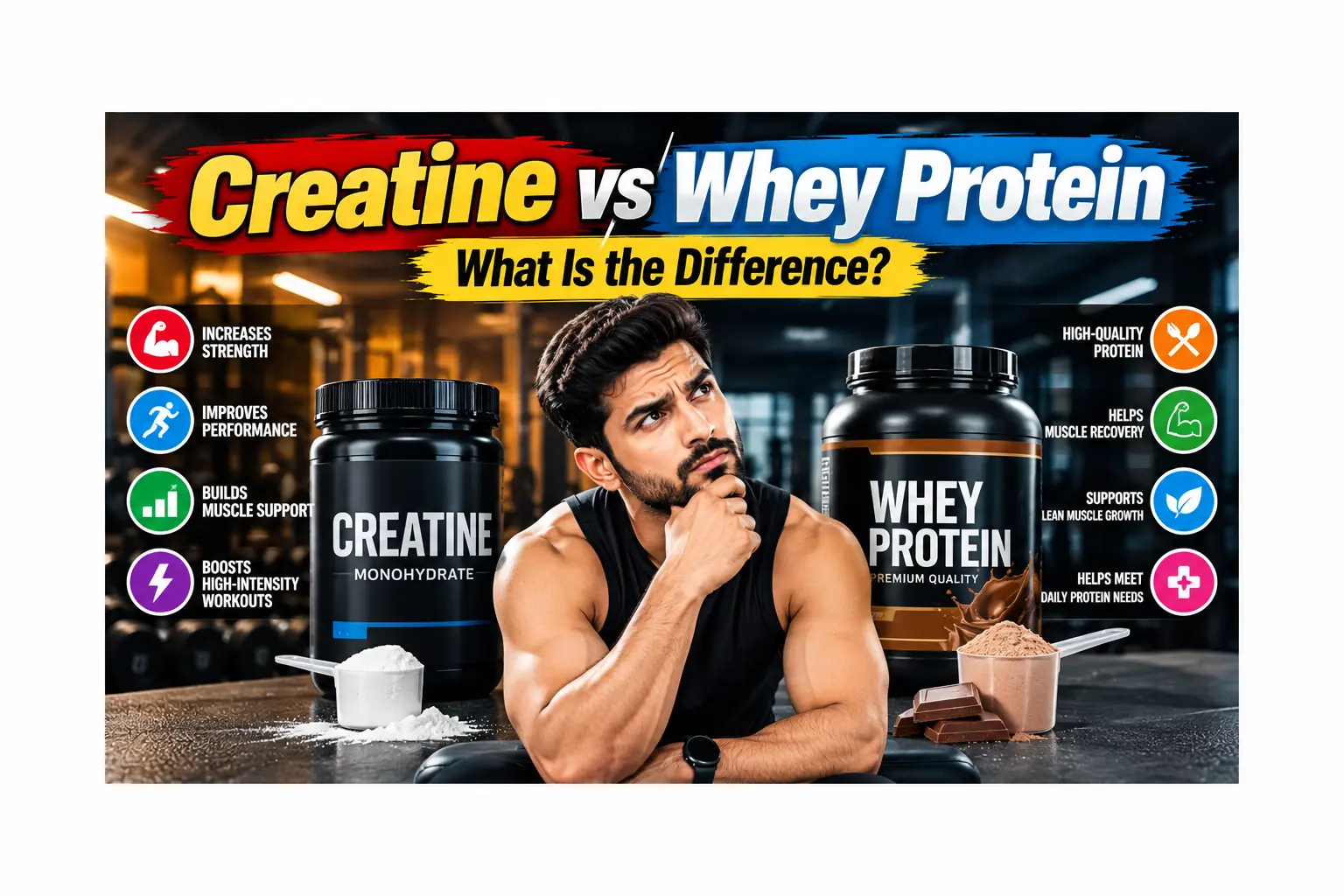
If you have recently started going to the gym, you have probably heard about creatine and whey protein.
Many beginners think they are the same thing or that one can replace the other. That is not true.
After more than 15 years of experience in fitness training, one thing I always tell my clients is this: supplements should support your training and diet, not replace them.
Creatine and whey protein have completely different jobs.
Whey protein mainly helps you meet your daily protein requirement. Creatine helps support high-intensity exercise performance and increases the amount of creatine stored in your muscles.
So, which one should you take?
The answer depends on your diet, training and fitness goal.
Let’s understand the difference in very easy language.
What Is Whey Protein?
Whey protein is a high-quality protein made from milk.
Protein is one of the main building blocks of our body. When you exercise, especially during strength training and weight lifting, your muscles need protein to support repair and growth.
Foods such as:
- Eggs
- Chicken
- Fish
- Milk
- Curd
- Paneer
- Soya
- Dal
- Beans
can provide protein.
Whey protein is simply a convenient way to add more protein to your diet.
For example, if your daily diet is not providing enough protein, having a whey protein shake can make it easier to reach your target.
Does Whey Protein Build Muscle?
Whey protein does not magically build muscle by itself.
Muscle growth requires a combination of:
- Resistance training
- Adequate protein
- Enough calories
- Proper recovery
- Good sleep
- Consistency

Whey protein can help provide the amino acids your body needs as part of this process.
What Is Creatine?
Creatine is a naturally occurring compound found in the body. It is also found in foods such as meat and fish.
Your muscles use the creatine-phosphocreatine system to help produce energy during short, intense activities.
This is why creatine is popular among people involved in:
- Weight training
- Strength training
- Bodybuilding
- Sprinting
- High-intensity workouts
- Power-based sports
The most researched form is creatine monohydrate.
Unlike whey protein, creatine is not primarily a protein source.
Its main purpose is different.
Creatine vs Whey Protein: The Main Difference
The easiest way to understand them is:
Whey Protein = Protein
It helps you meet your daily protein requirement.
Creatine = Performance Support
It increases muscle creatine stores and can support repeated high-intensity exercise performance.
Think about your gym session.
You perform squats, bench presses, rows and other exercises.
Your body needs energy to perform these movements.
Creatine supports one of the energy systems involved in short, intense efforts.
After your workout, your muscles also need adequate protein as part of the recovery and muscle-building process.
That is where your overall diet and protein intake become important.
Creatine vs Whey Protein for Muscle Gain
If your main goal is building muscle, both can have a place in your routine, but they do different things.
Whey Protein
Helps you reach your daily protein target.
Creatine
Can support strength and high-intensity training performance.
This is important because better training over time can help you make progress.
But remember something I tell my clients:
The supplement is not the workout.
You cannot take creatine or whey protein and expect muscle growth without regular resistance training.
Your basics should always come first.
Which Is Better for Beginners?
This depends on your diet.
If you are already eating enough protein every day from foods such as eggs, dairy, chicken, fish, paneer, soy or other protein-rich foods, you may not need whey protein simply because you joined a gym.
Whey protein is mainly a convenience.
If you struggle to get enough protein from your normal meals, it can be useful.
Creatine is different because you don’t take it simply to increase your protein intake.
If you are doing regular strength training, creatine monohydrate is one of the most researched sports supplements.
So don’t ask:
“Which supplement is better?”
Ask:
“What does my body and training plan actually need?”
Can You Take Creatine and Whey Protein Together?
Yes.
There is no need to treat them as competing supplements.
Many people use both because they serve different purposes.
For example:
Post-workout shake:
- Whey protein
- Creatine
- Water or milk
This can be a convenient option.
But you do not have to take them together.
You can take creatine at another convenient time and have your whey protein when it fits your nutrition plan.
The important thing is your overall daily nutrition and consistency.
How Much Whey Protein Should You Take?
There is no single amount that every person needs.
Your total protein requirement depends on factors such as:
- Body weight
- Age
- Training level
- Fitness goal
- Overall diet
- Activity level
For people who regularly perform resistance training, a daily protein intake around 1.4–2.0 grams per kilogram of body weight is commonly recommended for supporting muscle growth and maintenance.
For example, a person weighing 70 kg may have a daily protein target somewhere around 98–140 grams, depending on their individual situation.
That does not mean all of this protein should come from whey.
Your meals should provide most of your nutrition.
Whey is simply an easy option when food alone is not convenient or sufficient.
How Much Creatine Should You Take?
For many healthy adults, 3–5 grams of creatine monohydrate per day is a commonly used amount.
Some people use a loading phase, where they take a larger amount for several days.
But beginners should understand one important thing:
You do not have to load creatine.
A regular daily dose can also increase muscle creatine stores. It simply takes longer.
For most people, keeping the routine simple is easier.
Creatine Before or After Workout?
This is another question I hear regularly.
People often ask:
“Coach, should I take creatine before my workout?”
Or:
“Is creatine better after training?”
The exact timing is not something you need to obsess over.
Creatine works mainly through regular supplementation and increasing muscle creatine stores over time.
You can take it before your workout, after your workout or at another convenient time.
The important thing is consistency.
When Should You Take Whey Protein?
Whey protein is also more flexible than many beginners think.
You do not have to drink it within a few minutes after your final set.
You can use it as part of your normal diet when it helps you reach your protein requirement.
For example:
Breakfast
Eggs + oats + milk
Lunch
Rice + dal + vegetables + paneer or chicken
Post-workout
Whey protein shake
Dinner
Paneer, chicken, fish, eggs or another protein source
The overall daily protein intake matters much more than obsessing over a perfect minute.
Creatine vs Whey Protein for Weight Loss
This is where many people become confused.
Neither creatine nor whey protein is a fat-burning supplement.
If your goal is fat loss, your overall calorie intake, food choices, physical activity and training routine matter.
Whey protein can be useful during fat loss because protein helps support muscle maintenance and can make it easier to reach your protein target while managing calories.
Creatine can also be useful for people doing resistance training while losing fat because maintaining training performance and muscle mass is important.
But don’t expect either supplement to directly “burn belly fat.”
There is no magic powder that replaces a proper fat-loss plan.
Does Whey Protein Make You Fat?
This is a common myth.
Whey protein itself does not automatically make you fat.
Body fat increases when your overall calorie intake is consistently higher than your body’s energy needs.
A whey protein shake contains calories, just like other foods.
If you add large amounts of calories to your diet without considering your overall needs, weight can increase.
The solution is not to blame whey.
Instead, look at your complete diet.
Does Creatine Make You Fat?
Creatine can cause an increase in body weight for some people, particularly because increased muscle creatine storage is associated with additional water stored in muscle.
That is not the same thing as gaining body fat.
If your weight increases after starting creatine, don’t immediately assume that you gained fat.
Look at other measurements too:
- Waist size
- Progress pictures
- Strength
- Muscle measurements
- Workout performance
- Long-term body-weight trend
Does Creatine Give You Bigger Muscles?
Creatine can support training performance and increase muscle creatine stores.
Over time, when combined with proper resistance training and nutrition, this can contribute to improvements in lean body mass and strength.
But creatine is not a shortcut.
If you don’t train properly, don’t eat properly and don’t recover, taking creatine will not fix the problem.
Can Women Take Creatine and Whey Protein?
Yes.
Both creatine and whey protein can be used by women as part of an appropriate fitness and nutrition plan.
Women who strength train may use whey protein to help meet protein requirements and creatine to support training performance.
The idea that these supplements are only for men is simply a misunderstanding.
The correct choice depends on the individual’s diet, training and health circumstances.
What Should You Choose: Creatine or Whey?
Here is a simple way to decide.
Choose Whey Protein If:
- You struggle to get enough protein from food.
- You have a busy schedule.
- You need a convenient post-workout protein source.
- You are trying to build or maintain muscle.
- You want an easy way to increase your daily protein intake.
Consider Creatine If:
- You regularly perform resistance training.
- You want to support strength and high-intensity exercise performance.
- You want a well-researched sports supplement.
- You are consistent with your training.
You Can Also Use Both
If your diet and training plan support it, you can use both.
They are not replacements for each other.
What I Recommend to Gym Beginners
After more than 15 years around fitness training, I always tell beginners to follow this order:
Step 1: Build a Workout Routine
Train consistently.
Step 2: Improve Your Diet
Eat balanced meals with enough protein, carbohydrates, healthy fats, vegetables and fruits.
Step 3: Sleep Properly
Recovery is part of training.
Step 4: Drink Enough Fluids
Hydration matters for normal exercise and recovery.
Step 5: Track Your Progress
Look at strength, measurements and fitness rather than only the weighing scale.
Step 6: Add Supplements If Needed
Only after the basics are in place should you worry about supplements.
This approach works much better than buying five different supplements on your first day at the gym.
Common Mistakes People Make
1. Replacing Meals With Protein Shakes
A protein shake is a supplement, not a complete replacement for a balanced diet.
2. Taking Too Many Supplements
More supplements do not automatically mean better results.
3. Forgetting About Calories
Even healthy foods contain calories.
4. Not Training Consistently
No supplement can replace regular workouts.
5. Expecting Quick Results
Building muscle and losing fat takes time.
6. Copying Someone Else’s Diet
Your nutritional needs may be different from your friend’s.
7. Ignoring Sleep
Recovery is just as important as training.
Whey Protein vs Creatine: Quick Comparison
| Feature | Whey Protein | Creatine |
|---|---|---|
| Main purpose | Helps meet protein needs | Supports high-intensity performance |
| Main nutrient/compound | Protein | Creatine |
| Muscle building | Supports muscle growth when protein needs are met | Supports training and muscle adaptations |
| Protein source | Yes | No |
| Common form | Whey concentrate or isolate | Creatine monohydrate |
| Typical use | When extra protein is needed | Regular daily supplementation |
| Works as a meal replacement | Not a complete meal | No |
| Suitable for strength training | Yes | Yes |
| Suitable for beginners | Can be | Can be |
| Fat burner | No | No |
Final Thoughts
If you remember only one thing from this article, remember this:
Whey protein and creatine are completely different supplements.
Whey protein helps you increase your protein intake.
Creatine helps increase your muscle creatine stores and can support high-intensity training performance.
You don’t necessarily have to choose between them.
Depending on your diet and fitness goals, you may use one, both, or neither.
Your biggest results will still come from consistent workouts, good nutrition, proper recovery and patience.
If your goal is muscle gain, fat loss, strength or overall fitness, a structured training plan with professional guidance can make the process much easier. At Bodyzone Fitness & Spa in Chandigarh, personal training and different group fitness options can help you build a more structured approach to your fitness journey.
Frequently Asked Questions
1. Is creatine better than whey protein?
Neither is simply “better.” They have different purposes. Whey protein helps meet protein requirements, while creatine supports muscle creatine stores and high-intensity exercise performance.
2. Can I take whey protein and creatine together?
Yes. They can be used together because they perform different roles.
3. Which is better for muscle gain: creatine or whey?
Both can support a muscle-building program in different ways. Whey helps provide protein, while creatine can support strength and training performance.
4. Can beginners take creatine?
Healthy adults who are beginning resistance training can consider creatine, but supplements should be part of an overall training and nutrition plan.
5. Does whey protein increase body fat?
Whey protein does not automatically increase body fat. Your total calorie intake and overall diet determine whether you gain or lose body fat.
6. Does creatine increase body weight?
It can. Creatine may increase body weight partly because of increased water associated with muscle creatine storage. This is not the same as gaining body fat.
7. How much creatine should I take?
A commonly used daily amount is 3–5 grams of creatine monohydrate for healthy adults.
8. Do I need whey protein if I eat enough protein?
Not necessarily. If you already meet your protein needs through normal foods, you may not need whey protein.
9. Can women use whey protein?
Yes. Whey protein can be used by women who need a convenient source of dietary protein.
10. Can women take creatine?
Yes. Creatine can be used by women as part of an appropriate fitness program.
11. Should I take creatine before or after my workout?
The exact timing is less important than taking it consistently. Choose a time that fits easily into your daily routine.
12. Can I build muscle without supplements?
Absolutely. A well-planned diet, resistance training, adequate protein, sleep and consistency are the foundation of muscle growth. Supplements are optional tools.
13. Is creatine a steroid?
No. Creatine is not an anabolic steroid. It is a naturally occurring compound involved in energy production.
14. Is whey protein a steroid?
No. Whey protein is simply a protein derived from milk.
15. Which should I buy first, whey protein or creatine?
Look at your actual need. If your diet is low in protein, whey may be useful for convenience. If you already eat enough protein and regularly perform strength training, creatine may be worth considering.
16. Should I talk to a doctor before using supplements?
If you have a medical condition, take regular medication, have kidney or liver problems, are pregnant or breastfeeding, or have another health concern, speak with a qualified healthcare professional before starting supplements.
Leave a Reply